Sunday, February 22, 2009

Haruki Murakami's "The Seventh Man"


I think sharing what you like with others can be a powerful way of expressing yourself. I think what the person sharing, hopes for, is that the sharer and the sharee can experience something together. It is more than just having something in common. It is experiencing similar thoughts and emotions as someone else. It is having an experience together. This might be where the true value of art lies. As my i-pod gives me experiences I wish there was someone else that was hearing the same thing I was hearing.

I must admit that I thought this was the "spirited away" guy. I was surprised because I don't really love Miyazaki movies. But I really loved this story. It makes sense that the stories have different sources. The first part of this link is the story i would like to highlight. The Seventh Man as read by John Shea. http://huffduffer.com/Clampants/2575

Wednesday, February 11, 2009

Telling people i am an artist fells like the beginning of a joke.

It must shock the hearer when i say i am an artist, because the response seems to be overdone. "wow, that's great" or "what do you want to do with that?" maybe i get "(spit take) cough, sputter... what?"
i am seen as a magical retard by the general population. they see the artist as someone that can do things that no other mortal can do and at the same time they believe life will break the artist for his/her optimistic embrace of life. As my parents (general population) you want to protect me. "Gian, look fire, HOT!" you parents also want me to transform the fire to ice cream. enough with the metaphors.
i am writing this post because right now my life feels like it is on hold. Andrea and i are waiting for grad schools to respond to my application. this time has made me think about what it means to be an artist and how crazy it is. i found this talk on creativity. the writer Elizabeth Gilbert is good at explaining creativity and artists. you will know me a bit better after you see her explanation.

Monday, February 02, 2009

Art 21 Gabriel Orozco | "Mobile Matrix"

Art 21 has given me a large part of my art knowledge. It might be uncool to admit that but thems the facts. Here is a clip were you get to see the construction of a public work of art. You also get to hear the artist speak about the art. I was surprised to find that a whale skeleton looks like a giant tadpole.

Tuesday, January 20, 2009

BFA final show at the Sego


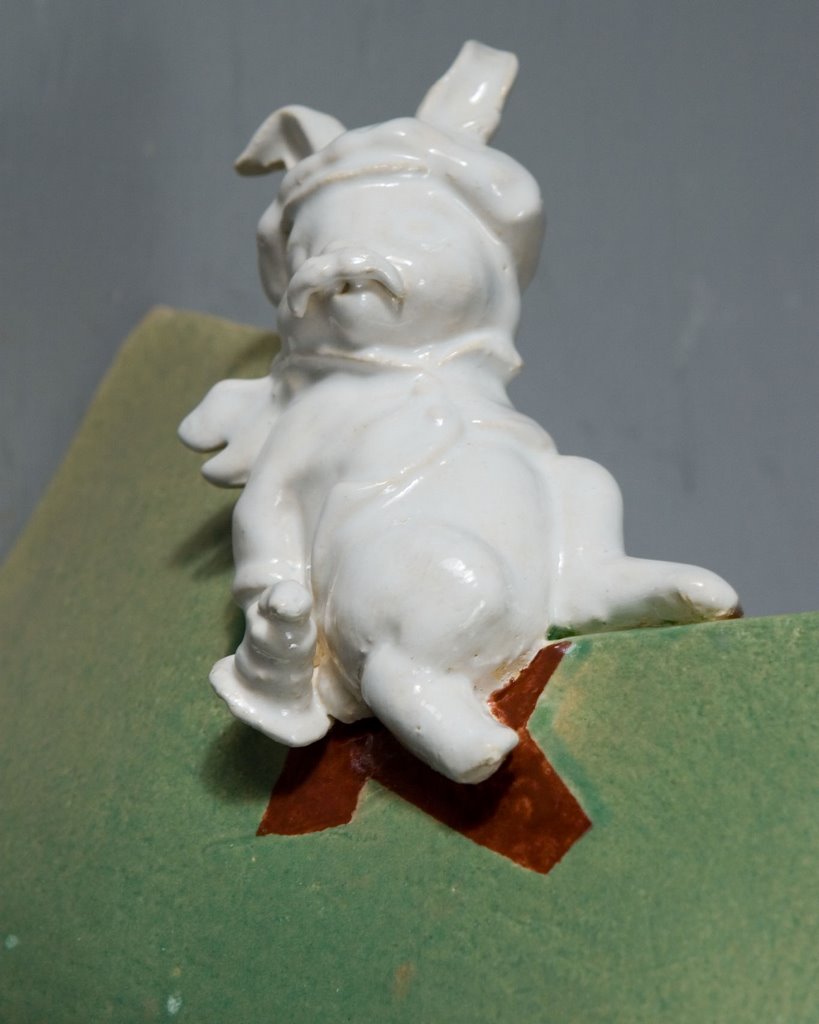
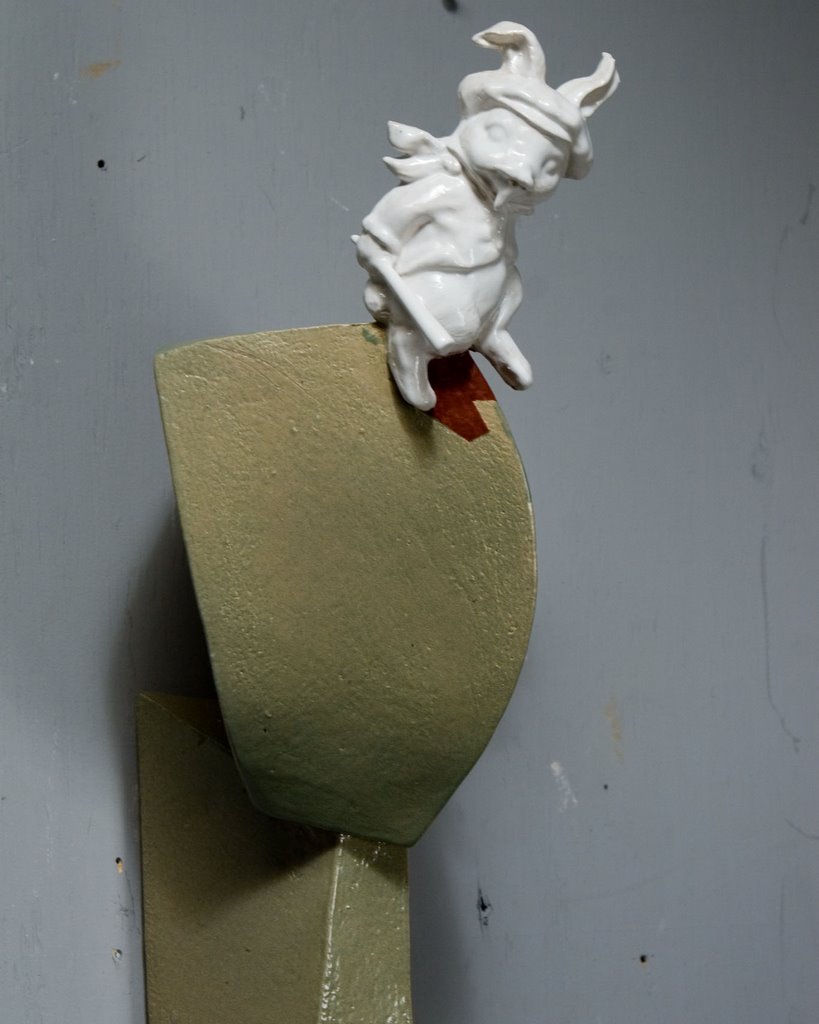
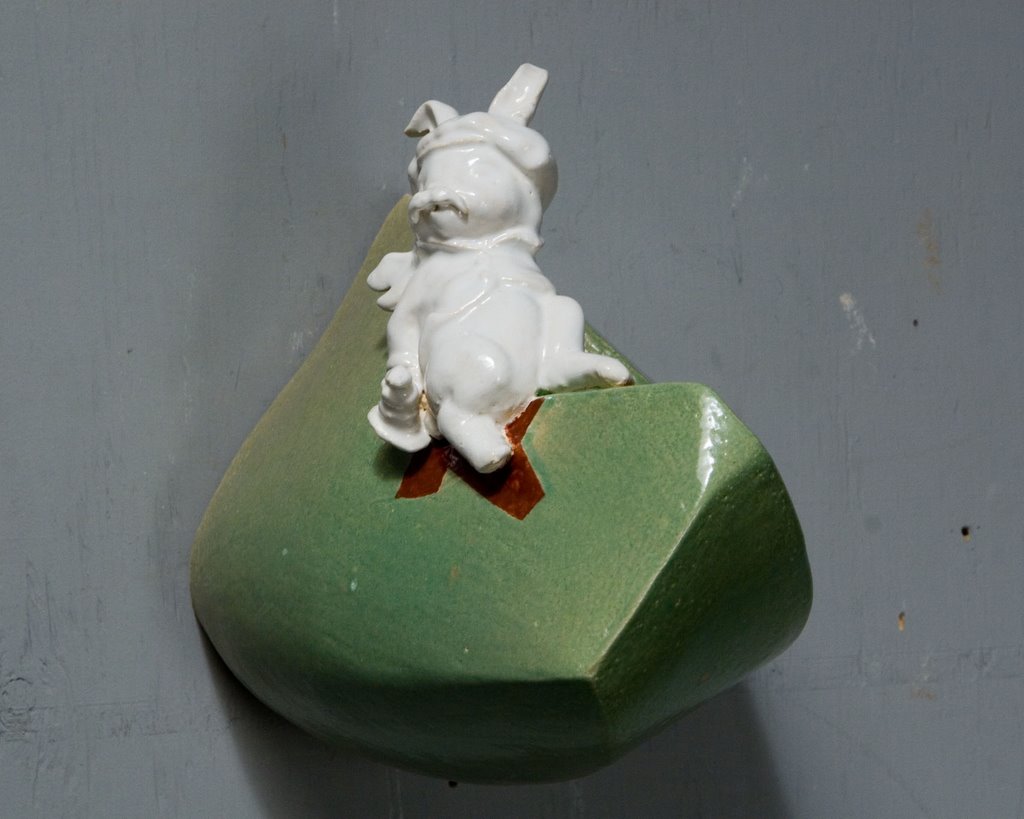
On 5 December 2008, the Sego Art Center will open What ought to be, an exhibit of new sculptures by local artist Gian Pierotti. The exhibit will feature an adjoining critical essay by writer and art historian Megan Whittaker.

In the Aristotelian tradition, art functions as an imitator, showing us what is, what ought to be and what might be. Though typically imitation in art is couched in the notion of representation, it is the imaginative process of imitation that is communicated tacitly, even instinctively, through the work in Gian Pierotti's new show at the Sego Art Center. Evolved from their earliest stages as formal variations on a Minimal theme, Pierotti's latest porcelain sculptures encase small polygonal shapes in architectural exoskeletons that may be disassembled and reassembled. The results are a playful advancement of an archaic process. The unique forms are deliberately accidental, artificially organic and defy any one direct referent.

Yet the work is both immediately familiar and immensely satisfying. Fitting together the pieces of one of Pierotti's works is as gratifying as locking together two Legos or snapping Construx into place. The toys of childhood are the tools of imaginative imitation, teaching us how to act as adults. Pierotti's works, fantastic constructed entities that call upon us as viewers to animate them, remind us to embrace childlike wonder in the gallery. In the aftermath of Postmodernism, the trend in art has been toward what ought to be – both formally and contextually. The reward of Pierotti's work at Sego Art Center this month is that it offers up what art might be. And what art might be is fun.


Friday, November 28, 2008

I have been listening to podcasts for more than a year now.

My top three are:
1. Radio Lab... The two hosts have a great sense of humor and are able to present science in a way that helps you understand how you fit into this world. It is an artful approach to science. They give new wonder to the world around us. Here is one of my favorites. http://www.wnyc.org/shows/radiolab/episodes/2007/08/05 click on "listen to the whole show"

2. My next favorite podcast is 606 5 live call in show with Danny Baker. It has got to be the one with Danny Baker because Alan Green and Tim Lovejoy are both pratts, Spoony is alright, I guess. Okay, now stay with me. Usually this is your regular English football call in show where people windge about the refs. But on Tuesday night Mr. Baker turns it into story time. People call in to tell stories about topics like "what crazy object have you been hit with while attending a football match." or "where have you seen people wearing English football jerseys outside of England?" This link has an American calling in this is not the norm http://www.bbc.co.uk/fivelive/programmes/606withdannyb/audio.shtml

3. The classic Tales podcast With BJ Harrison. This guy was in my old ward. He reads scripture very well. He can really project. The classic tails podcast is Bj reading from classic literature. I put this in as my third place pick because this podcast really lets me get taken away with the story. Just today I heard the story Rikki Tikki Tavi. I had forgotten how good that story is. Maybe I am a sucker for "a boy and his mongoose" stories. I couldn't find the rikki tikki tavi story but you can't go wrong with an O Henry story. http://cdn1.libsyn.com/classictales/CT_83_Thanksgiving_in_NY.mp3?nvb=20081129035054&nva=20081130040054&t=01d8acd5da7d0800d173d

Friday, November 14, 2008

My winter 09 mix


1 Red Yellow And Blue (White Williams Mix) ...Born Ruffians

2 Kettle Drum (I Left A Note) ... Pale Young Gentlemen

3 Undo... Björk

4 Voice in Headphones ... Mount Eerie with Julie Doiron and Fred Squire

5 Vänerhavet ...Detektivbyrån

6 Compass ... Absolutely Kosher Records

7 Royal Blood ...The Witchies

8 The Hundredth Time ...Gigi

9 All the Way Down ...Nik Freitas

10 Bloody Sunrise ...Neil Gaiman

11 Phantom Anthills Chad ...VanGaalen

12 Tonight ...Lykke Li

13 Track 01 ...Okay ??????????????

14 Diamond Rings 2007 ... Deer Tick

15 Be Kind To Me ... Michael Hurley

16 Rolling Sea ...Eliza Carthy

17 Blood Red Roses ...Sting

18 Bully In The Alley ...Three Pruned Men

19 Hog-Eye Man ...Martin Carthy & Family

Thursday, November 13, 2008

Bjork's "Undo"

I know because of my infrequent posting you hardly come to my blog. Its okay i don't blame you. I guess what i want to share with you is my re-admiration for Bjork. I really think she is great. For my english class i had to do a analysis of a work of art. i chose "Undo" of of the Vespertine album.
Andrea and I were just talking about how brilliant a thing can become if we invest time and focus to it. Undo was a pretty song. Now to me it is a masterpiece. Here is my analysis of Bjork's "Undo". And a live performance at the Royal Opera house in London.
This is an analysis of the song “Undo” by Bjork.

Bjork and I go way back to 1992. In high school I thought you pronounced the “j”, like an English “j”. Boy was I wrong. Now in college I know that foreign words with “j’s” have a “yu” sound.
This song has very simple lyrics. The arrangement of the music feels simple but when looked at closely one finds the progression of the song is unpredictable. It has many subtle layers. Sonically, the song matches perfectly with the lyrics and its total concept.
The main theme of the lyrics cover the fact that life is not supposed to be hard. “It’s not meant to be a struggle”, sings a chorus of angels. Bjork then gives you a soft loving pep talk. She wants you to see that life is good. “It’s warmer now”, as she kind of whispers to the listener. The lyrics are simple and profound. But the music of the song is the moving force. The message of the music is one of reality. What is real, and is reality all that great? The song answers these questions in combination with both the music and the lyrics. Its answer is, "It’s all real and yes, reality is so great."
The music has an otherworld feeling to it. But the lyrics let you know darn well she is talking about earth. The instrument that best gives an otherworld sound is the synthesizer. The synthesizer at once has a feeling of alienation and familiarity. The sound is generated with perfection yet we know it is not real some how. The title of the song “Undo” is linked closely to the synthesizer or the computer. Undo is familiar to us in this computer age as a “do over”. To “undo” is to right a wrong. There is a strong duality of technology and biology in this song and I find it clever that both are used to create this song. The first sounds you her are a sort of piano sound but maybe you are using ears that have water in them. Bjorks voice comes right in at the beginning but it has all sorts of vocal effects like an echoing delay, her inhales seem exaggerated, and there are two vocal tracks running at different times, this makes an echoing refrain in the beginning. A rich life filled texture is created with her inhales and exhales. These sounds are so familiar to us. We breathe all our lives. Sonically different sounds are weaving into and around each other. The music moves slightly closer to earth with a recognizable instrument. The sound of the harp flutters into the song letting you know it is not outer space you are hearing but heaven. Then comes the biology technology. Sound effects are creaking, shaking, there are biggish sounds, and rustling. A count or two later the beat comes in. The beat gives an important toehold to the listener who is used to the Pop music aesthetic. It should also be mentioned that at the time this song was made, beat driven music had a strong presence in America that had recently come across the Atlantic. The beat is not straightforward, but it gives the listener something familiar. Maybe it is a recording of a heartbeat of someone with three hearts, a mother with twins or maybe a celestial being from another galaxy. As the beat begins there is a floating feeling to the song. The chorus and all the sounds float with us for a few minutes, there is a calm euphoria, and then one by one the layers of sounds go away. The volume of the chorus comes down. The stringed instruments begin to fade away. Our ears are left with a lower toned harp sound and Bjork’s soft positive affirmations. The beat stops and the song winds' down. The sound becomes distorted and fuzzy, not in an analog way but in a digital way. The sounds are not dissonant. They are strangely comfortable. And then you are left with silence that sounds good not because you are glad the song is over but because everything is magic and everything is more real even the silence.


Monday, September 15, 2008

Hi ho friends, here is a post about my art show at the CUAC


I have an art show up at the Central Utah Arts Center. I have the opportunity to share the space with the painter Sunny Belliston. The opening has already come and gone. I am grateful for the friends and family that made the long journey. There will be a lecture given on Thurs. @ 7:00pm by Jeff Lambson of the BYU MOA. He is the current Contemporary Curator and has already made an amazing impact.
I did a short interview for the local public access TV guy. You can see it on YouTube here.

Tuesday, May 13, 2008

Okay, i wonder if you will like this.

I found a funny little phone prank. you can hear it here: http://www.fluxblog.org/2008/05/strobe-light-was-my-mind.html
click on the link that says this:
Andrew Earles & Jeff Jensen "My Friends Call Me Ditchweed. Don't Ask. Okay, Go Ahead and Ask."

Sunday, September 02, 2007

The weekend of Sept. 22 and 23


on Saturday night by the state mental hospital, Midwife Crisis will perform another last final show for the last time... again. Matt has decided he wants to come back to utah to play the songs we used to play. we will be the last act of the sago arts festival. I approach this date with great excitement and trepidation. I get nervous just thinking about it. NOT! It is cancelled. Not the sago fest but the midwife show.


Sunday on PBS there will be the first part of the the Ken Burns documentary "The War". I saw Mr. Burns (ha) speak when he came to BYU. he is a great speaker and i like his approach to history. He doesn't see life as ordinary and he finds many extraordinary stories. as he spoke in the marriott center, i found myself feeling like i was proud to be an american. i think i had this feeling because the true stories told of the people of the second world war, were stories of selfless sacrifice told with humility. i hope you will check out the clips found on this site. http://stripesandvelour.blogspot.com/

Tuesday, August 07, 2007

My scooter has been stolen.

As i went out to the garage i pulled open the door and my heart dropped. there was no cute green scooter in there. after some light cursing i called the police. i am sick just writing about it. as sad as this is deep down i accuse the Hispanic family next door. i don't think they had anything to do with it but i think it helps me feel like i have some control.

Friday, July 20, 2007

Proun History Bright Future


The Pierotti family has decided to follow an English football club. After lots of research i have decided that the team for our family is Aston Villa. they are a mid-table team that is poised to be a more successful side. They have an american owner (Randy Lerner) and a highly rated manager (Martin O'neil). Nike is the new kit sponsor and they have a brand new training fasility.
I do admit i am a bit jelious of the bigger clubs like man u and liverpool they get most of the top players. but i like an underdog... but not too much of an underdog.

Tuesday, July 17, 2007

It has been a while

what can i say? i haven't been so busy i couldn't write. it is not like there hasn't been anything to write about. i mean come on, Paris Hilton went to jail. i could have given my speculations for the up coming lost season. i have been on two vacations. i got andrea pregnant. i know that you all have stopped checking this blog. but i will try to get things going again.

Wednesday, February 21, 2007

Rickey's laugh

Remember The Office? The one in Great Brittin.
I found some XM radio clips of Karl Pillkinton, Stven Merchent and Rickey Gervais on YouTube. I thought they where great fun to listen to. I can't help but giggle along with Rick.

rick steve karl

Saturday, January 20, 2007

The Beaver Rich Little. The rich little beaver.


If you have spent a good amount of time in Utah, you might know the film maker Trent Harris. His most famous movie is "Rubin and Ed". I guess his movies are best described as strange. Finally his movie "The Beaver Kid Trilogy" is on youtube. You can watch the whole thing in ten parts. http://youtube.com/watch?v=L18CSMd93BU
There is a good interview and explanation the "This American Life" people did.
http://www.thislife.org/pages/descriptions/02/226.html

Saturday, January 13, 2007

oldish art new photos


thanks Mo Fritz


Friday, December 01, 2006

you are probably thinking jeez Gian lighten up

I can read your mind. I read you loud and clear. I realize I have tried my hand at trying to talk about things that really matter to me. At first thought I thought that might be political issues. What is more important than the power struggle that has been going on for like a googolplex of years? It is obvious when the question is put, "What really matters to you?", to answer something along the lines of family and friends, oh we can throw God in there too. I know He reads this. I've got Kolob coming up on my google analytics.
Honestly speaking Andrea really matters to me. She is my greatest cheerleader. I mean that literally. there is a lot of cheering going on at the Pierotti home. She is so cute! Just look at her holding my nephew.
In future I will let you know what is going on around me. In short less politics more human interest. put even shorter, less p more hi.

Tuesday, November 14, 2006

The Christian Right Jean Bethke Elshtain

I have been taking advantage of the Forums at BYU. I think it is a wonderful way to hear different points of view. I realize BYU will not bring anyone too outrageous, but they have brought some very brilliant and accomplished scholars. On most Tuesdays I walk to the Marriot Center to hear an academic speak about their focus of study.

Sometime in October I listened to Jean Bethke Elshtain address her take on stem cell research and abortion. It was fascinating to hear her defend her pro-life and anti-stem cell research position in a logical way. This was the first time a conservative person didn't only focus on the fact that "babies are dying! Don't you care?!" She, with the help of Elder C. S. Lewis, made it a philosophical question. For example "what is the value of a life?" and "what is human?" This stuff is right up my alley. Before you start wondering about my possible conversion, I must let you know that I did disagree with her on some points. She conveniently only brought up anecdotes that supported her position. This may have been because of time. But, it made her presentation seem like she was over simplifying the issues.
You can hear her speech: http://speeches.byu.edu/index.php?act=browsespecialized&mediatype=&year=.5


You can also read about her theories about justifiable war and Iraq.


Jean Bethke Elshtain Responds
By Jean Bethke Elshtain
Summer 2006
Whether in agreement or demurral, one reads Michael Walzer with interest and respect. His work is a welcome contrast to the vicious rhetoric of accusation and denunciation that is so much a part of our public life. The basics of Walzer’s argument are straightforward: is regime change a just cause for war? (Presumably this means can regime change as such ever be a just cause.) My answer to this question is, No, not in and of itself as an abstract proposition. However, in a given case and in light of other factors and additional information, regime change may well be one feature of the deployment of justifiable force. This is not equivocation but a recognition that the just war tradition does not present a series of boxes to check, and, should you get more than a given number, then war it is. Just war doesn’t function like that, as Walzer points out in his classic work, Just and Unjust Wars, a text that has played a central role in the revival of just war thinking in our time. The just war tradition is thick with the soot of history and cannot be wrenched free from particular cases, as Walzer insists. It is true that regime change was not a stipulated goal at the onset of World War II. As the war went forward, regime change came into focus as a compelling and legitimate war aim. (Even as bringing an end to chattel slavery gained momentum as a war aim during the Civil War, although it wasn’t the casus belli at the outset.) It would be odd for someone to claim that “just cause” in the Second World War was besmirched because regime change wasn’t articulated from the get-go as a sine qua non for the use of force. The fact that regime change is not articulated as overriding at the outset does not invalidate an otherwise strong case. Whatever one thinks of regime change in Iraq, the argument that the use of force in such matters is always illegitimate unless it is undertaken collectively is false, as the UN charter demonstrates. Any argument against a nation’s use of force, including pushing for regime change, must proceed on other grounds if it is to be compelling. Walzer recognizes this in a way many of the loudest voices do not.I dissent somewhat from Walzer’s claim that in the classical formulation of just war “aggression is regarded as the criminal policy of a government, not as the policy of a criminal government.” This gets tricky. It may not be a rule, but there is a very strong probability that a criminal regime—whether Fascist, communist, or Baathist—will engage in criminal policies externally and internally. Such regimes “bear watching.” This leads us to ask what criteria are deployed to determine whether the internal abuses of a regime are of an egregious and systematic sort that may—if other factors are present—trigger intervention. Here we arrive at “humanitarian intervention.” But under whose auspices, given what criteria, and to what end or ends? This is deeply contested, as is the norm of a “responsibility to protect” (RTP) now proffered routinely as an international duty of a sort. RTP derives from a hard-hitting document issued under the auspices of the United Nations that declares that a UN member state or group of states may be justified in intervening in the internal affairs of a criminal or rogue state engaged in systematic and egregious crimes against its own people or an identifiable portion of its people. For some of us, RTP was important in evaluating Iraq and the use of force.Walzer’s overall position in these matters might be described as “minimalist universalism.” For example, a nation or group of nations may have just cause to deploy force to stop genocide, but the same cannot be said for the practice of genital sexual mutilation. That disturbing custom, and how to modify or end it, is best left in the hands of a given country and open to pressure from international human rights groups. This is Walzer’s position as I understand it. There is no “bright line” here. Each case must be evaluated along the entire menu of just war considerations. Additionally, cultural transformation is not so easily severed from political change—as Walzer appears to suggest. The cultural transformations attendant upon regime change in post–World War II Japan demonstrate the legitimacy that enforced cultural transformation may acquire over time. The character of the Iraqi state told us a lot about the nature of the Saddam regime and the culture out of which it emerged. These political-cultural factors were not irrelevant to the negative assessments of that regime by several American administrations. To be sure, weapons of mass destruction (WMD) featured foremost in the denunciations by then-President Bill Clinton, Vice President Al Gore, and Secretary of State Madeleine Albright, who declared that Saddam’s Iraq possessed sufficient WMD to “destroy all of humanity.” Given that the nature of the Iraqi state was such that effective internal transformation could not be anticipated, such statements played into fears about WMD and assessments of Saddam’s willingness to use them, given his horrific attack on the Kurds. The culture of a “republic of fear” is surely relevant to how one makes determinations about the use of force.THIS MEANS THAT the Iraq case is something very different from the possession of WMD as a stand-alone fact. Here, the empirical record—I’ve mentioned the Kurds, but one must include the brutal suppression of the Shiite uprising, the destruction of the way of life of the Marsh Arabs, the horror of Saddam’s children’s prisons, systematic torture as a policy, arbitrary arrest, and on and on—all figure into how one weighs concerns about possession of WMD. Significant as well, and adding additional heft to the WMD issue, was Iraq’s defiance of the terms of the truce ending the Persian Gulf War of 1991. Any state in breach of peace terms and believed to possess WMD will trigger a more negative assessment than a relatively transparent democratic state not similarly in breach and in defiance. Or, for that matter, a very nasty regime that has, up to this point, stood down from terrorizing its own population systematically or actually using WMD. Regime change in Iraq cannot be severed from these, and other, considerations. Walzer throws down the gauntlet to those of us who supported intervention by claiming that the “post–Persian Gulf War containment system” prevented both WMD development and mass murder. But who knew for sure? Unless Clinton, Gore, Albright, and Prime Minister Tony Blair, as well as President Bush, were, or are, all “lying,” there was sufficient compelling evidence of WMD to raise the level of concern and enhance the case for intervention.I am not convinced that the mass murder question is settled by observing that the gassing of the Kurds and the slaughter of Shiites, together with other egregious abuses, were all in the past. There are other forms of culpable killing; for example, the fact that by UN figures as many as eighty thousand Iraqi children per year were dying as a direct result of Saddam’s “gaming” of the oil for food and medicine program—a shameful episode in the history of a shameful regime. As well, embargo and sanction policies, although they may be justifiable in specific cases, are not necessarily ethically preferable to the use of force. The burdens of these policies fall disproportionately on a society’s most defenseless members: that is another debate for another day. For now, the upshot of my remarks is that a regime’s continuing policies, should they lead to the deaths of tens of thousands of innocent victims as a matter of policy, not unavoidable happenstance, must be taken into account as one fleshes out a case for—or against—intervention. Walzer’s claim that containment was a better option in the Iraq case than war is a prudential judgment flowing from the factors he takes into account and how he evaluates each. If one values sovereignty highly, as Walzer does, preventive war is very difficult to justify, but not impossible. Walzer is correct that there are occasions when “preventive force” can be justified. I believe that, on balance, the 2003 war against Saddam’s Iraq was one of these; Walzer does not. This is a “family quarrel.” I suspect that I am giving heavier consideration to the earliest formulations of the just war tradition (for example, St. Augustine’s), which argued that an outside party may be justified in intervening in a state in order to prevent certain harm to the innocent. Fascinatingly, these early formulations connect directly to the current norms of humanitarian intervention and RTP.TWO FINAL POINTS: it is annoying, as Walzer points out, that many of the Western European leaders calling vociferously for maintenance of the containment regime were unwilling to put their shoulders to the wheel by way of personnel, equipment, and treasure in order to ensure its enforcement. The elites and leaders in Western Europe present a troubling picture. Much of the time they seem not to be at their posts. It is vexing, to put it mildly, when the (alleged) moral high ground is seized by those prepared for the United States to provide for the defense of the West generally as well as its own security, even as anti-Americanism is rampant and American culture is treated with burning contempt.The hard fact of the matter is that many alternatives to the use of force cannot be implemented or even initiated until coercive force is deployed to stabilize a situation. You cannot use “soft power” effectively in the thick of a situation akin to Hobbes’s war of all against all. Although I do not share Walzer’s overall hopefulness where “indirection” is concerned, I join hands with him in a commitment to minimal justice for all beleaguered peoples, tormented by the brutal, that we too readily ignore or forget.